Ruminations

The Fallacy of Quantum Computing and Decryption

CERTAINLY we all agree that using quantum computing to instantaneously evaluate all possible outcomes in a seemingly singular clock-tick is utterly fascinating. The ability to take a bucket of Qbits, throw some tremendously complex math at it ,and get all the results in a single execution is nothing less than mind boggling. Your mind is likely “boggled” as we speak (or shall I say, as we read).

But wait a minute…

Just how can someone use this computing capacity? How many problems in the world really need the ability to calculate an enormous number of permutations with blazingly fast precision? You would be surprised. Consider the complexity of forecasting the weather, or fluid dynamics, or (wait for it…) cracking complex mathematical hashes.


If you haven’t been keeping up with the latest in Quantum Computer, here are a couple quick links for you:

https://en.wikipedia.org/wiki/Quantum_computing
https://www.nationaldefensemagazine.org/articles/2021/12/27/quantum-and-the-future-of-cryptography
https://www.ibm.com/quantum-computing/what-is-quantum-computing/


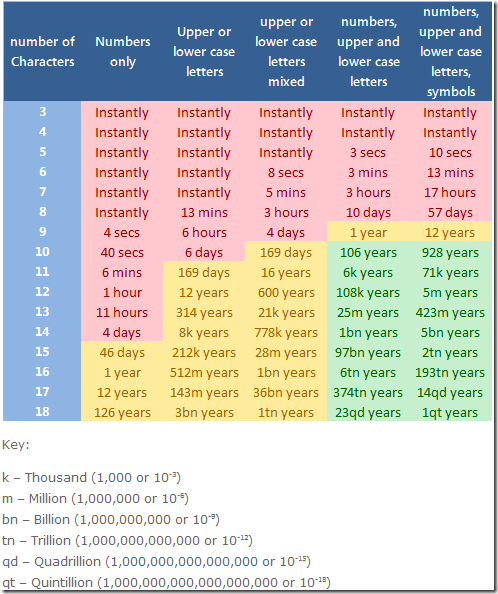
Naturally cybersecurity experts saw the promise of quantum computing and realized there were some pretty amazing tricks Qbits could be tasked to do. Encryption and decryption are perfect examples. More specifically consider something like the lowly password. How long it takes to brute force crack various password character combinations has been studied and documented numerous times over the last decade. A quick Google of the phase “password strength chart” will yield numerous graphics similar to this…
password strength

Get Cracking

Who in their right mind would spend 106 years of compute time to crack a 10 character password consisting of numbers and upper/lower case letters? You could be dead before the brute force attack finished. Obviously your no “dim bulb”. You see where this is going, right?

The only reason the crack takes 106 years is because the person who calculated that chart has to run the brute force attack serially (or at least in a very limited, parallel manner, depending on the amount of compute threads they had available to them). They have to create a password, test it against the target system, and then try another until they eventually get through.

Sure, based purely on probability, one lucky person will get it on the first try and some terribly unlucky sod will crack the password 106 years later. Most will see results somewhere under the bell curve in the range of 50 years or so. It’s just daunting.

Enter those pesky Qbits and quantum computers with their ability to calculate all possible combinations in less time that it takes to blink your eye. Suddenly what took 106 years takes mere seconds.

Or does it?

The Fallacy of Quantum Computing

Now we get to the part that no one seems to talk about or at least wants to say out loud. We have talked about cracking passwords but in reality quantum computing could be used to crack any complex mathematical probability. Certainly, for a Qbit, decrypting a SHA256 hash is only a short step up from password cracking. Change the equation, add some more Qbits and let it rip. In the end you have a nice long list of possible values with which to start cracking.

Did you catch that? I wrote, “Start cracking….”

This is where I scratch my head. Perhaps someone far smarter than I can shed some light on this but when I apply the logic of my addled brain, a little voice tells me to hold up a bit (no pun intended).

Sure, quantum computing can generate all of the possible combinations to the password for my bank account. No doubt that in very short order the quantum computer operator would have a list of passwords that would invariably contain mine. Buried in a list of password combinations, amassing somewhere in the septillions of combinations, would be the golden ticket to raid my bank account and go buy a nice dinner for yourself, on me of course.

But how does the hacker know which password works? Sure they have the list of all possible results but each will have to be tested. This is the choke point that creates the quantum decryption fallacy. While the hacker may have all the possible combinations, the only way to determine which one is correct is to test each. Unfortunately quantum computing doesn’t help with this part.

As a result, the whole Qbit cracking effort was a waste of time (sure, it was only a second or two) because there is no reasonable way to find out which password works.

My bank doesn’t have unlimited compute power and certainly isn’t going to allow for septillions of combinations to be testing without shutting my account down. As a result, the whole Qbit cracking effort was a waste of time (sure, it was only a second or two) because there is no reasonable way to find out which password works. The same goes for decryption of various hashing or encryption techniques. At some point someone or something has to validate the result. If I have a value that is encrypted, and I use a quantum computer to decrypt it, someone has to validate all possible results to determine which one is valid. That takes time. Likely way too much time to be feasible.

Defusing Hysteria

Unfortunately you have read all the way to the end and I provided no solution. My apologies. My intent was only to tamp down some of the hysteria surrounding the use of quantum computing in cybersecurity. In my opinion there was been a bit too much fear mongering about the potential for quantum computing to expose our lives (and data) to nefarious forces.

It sound’s scary on paper but in reality decryption using quantum computing simply does not exist in a vacuum. The math is only one part of the cybersecurity equation. The validation is what saves us.

So the next time someone touts the phenomenal cosmic powers of quantum computing for decryption, sit back, cross your legs comfortably, clasp your hands behind your head in a relaxed pose and ask them, “So how are you going to test that?”. You might hear an barely audible pop as a small synapsis fires somewhere deep in the recess of their brain.
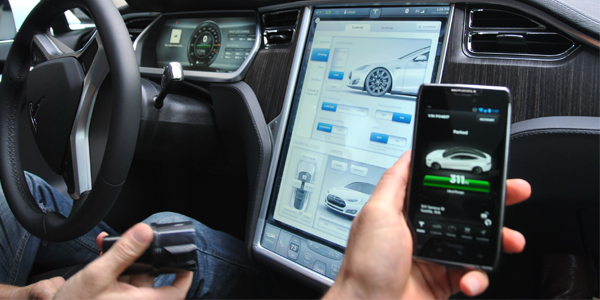
Pay attention, Tesla is NOT a car company!

I love all the articles by analysts talking about how Tesla stock is soaring, how their market cap is larger the Ford and GM, yada yada yada…..

The problem is everyone is missing the point. Tesla is NOT A CAR COMPANY, they are a Software and IT company. The magic of a Tesla is not the car, it’s the software and the IOT network behind it.

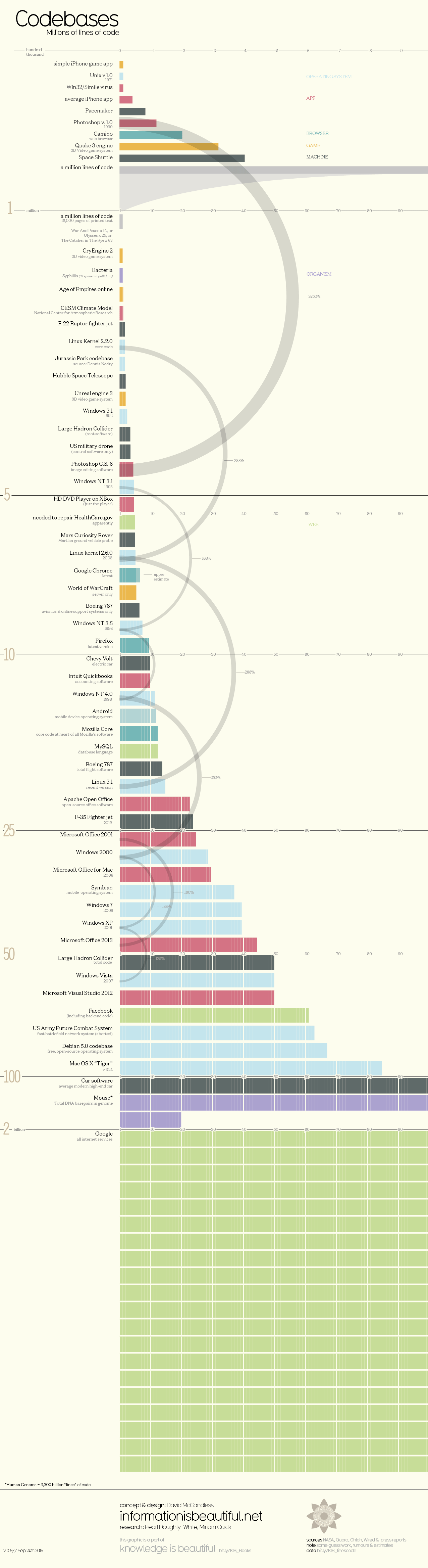
The average car, according to KPMG, has over 150 Million lines of code in it. As a Tesla owner, given the complexity of my car, I can only imagine my Tesla far exceeds that number.

I guess you have to experience it to really understand how critical the software and network are. In the past few years I have received numerous updates to my car and my phone. I have had conversations with tech support, driving at 80 mph, while they are remotely reading my log files and scheduling a software upgrade. I have rebooted my main and side console several times while driving safely at speed. The infotainment system is consistently adding new features and provides a plethora of features. I can’t even imagine the amount of quality control that goes into a software release considering the smallest flaw could cause death and severe decline in customer confidence.

So while everyone runs around expounding on how great the car is, the real attention and accolades need to be given to the software, QA, and network engineers who perform the real magic. A Tesla wouldn’t be worth $1 if the software and infrastructure did not work.

Car software has more LOC’s (lines of code) than Windows 10!

https://www.visualcapitalist.com/millions-lines-of-code/

Good car, Superior Software

Tesla is not beating other car companies with a good car, they are beating them with superior software and technology. It’s time the analyst industry started looking under the hood and realizing where the real magic lies.

My time on Mars.

Over the last 40 hours we have gotten two back-to-back snow storms yielding about 24 inches of snow in my yard. My wife and I have basically been stuck in the house for two days. (well, technically not stuck as I have a 4-wheel drive pickup I drive in the winter when the Tesla is packed away….I’ll take my Rivian NOW please!)

I’ll be honest. We have been getting antsy. I missed the gym workout yesterday (switched to today) and it was hard to concentrate on work at times. The need to get out of the house was an unspoken vibe.

It occurred to me at one point this is probably as close to feeling like a Martian that I will get. I’m OK with that….

Of course there is one HUGE difference. I can put on boots, a coat, gloves and go outside. For Martians, in transit or on Mars, there is no escape. Just knowing there was the ability to escape the house or that the storm would be over was a balm for my itchy need to get out.

On Mars, even going outside is still “inside” (spacesuit) as you can imagine. But that is only part of the psychological picture.

The big difference is having options.

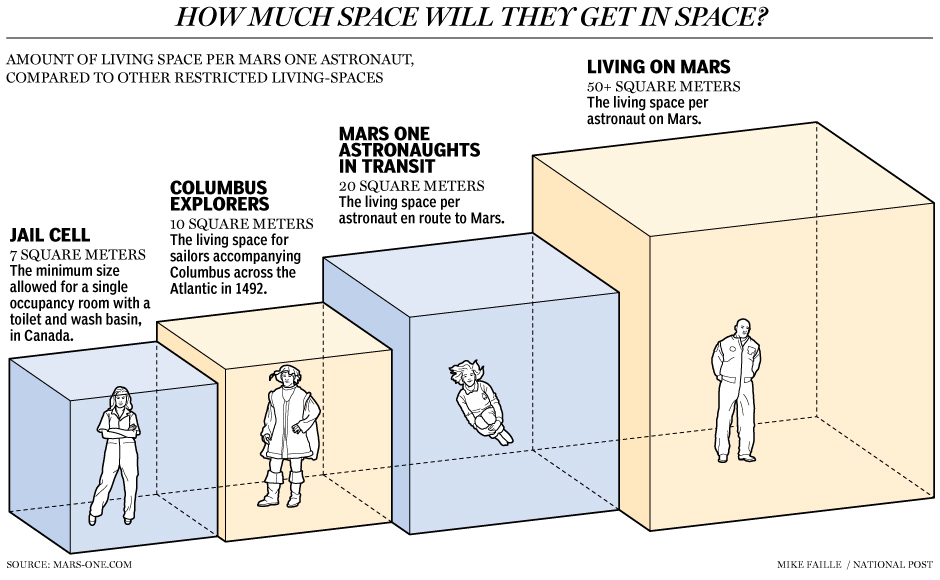
Cabin fever or Martian fever are two very similar but VERY different psychological experiences. The difference lies not only in the feeling of confinement but also in the conscious or unconscious knowledge that the condition is temporary (or not). We focus much on the confinement aspect of Martian living but tend to overlook the other factor that accelerates the metnal decline, options.

Options are the reason we watch the weather so much during a storm. Our subconscious needs the facts to stay calm, namely the impact of the storm itself, AND the knowledge of when life will return to normal, aka when the confinement will end.

So what is the Anti-confinement Confinement?

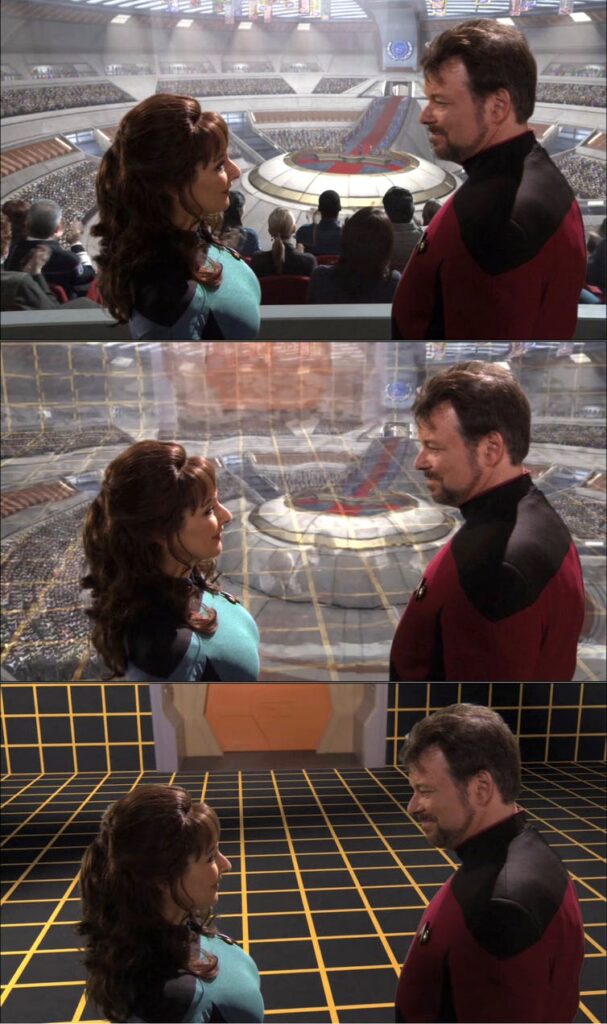
We all marvel at the concept of a holodeck in Star Trek but in many ways this “trick of the light” might be the only way to keep Martians sane. If you have ever worn a set of VR goggles you can experience this relief. I have experimented with the psychological effects of VR environments myself on cramped, long flights. Putting on the VR goggles with wide open spaces portrayed has a noticeable effect on the brains perception of confinement.

Living on Mars, like cabin fever, will require a two-part solution, one to deal with the physical confinement and the second to address the subconscious effects of the lack of options. Broader spaces may tamp down the feeling of confinement but tricking the brain into thinking there are options is the key to long term mental health and our ability to truly colonize other planets.

Owning an EV – A 1-month Retrospective

Tesla Model S 85
2014 Tesla Model S85

About a month ago, I bought a Tesla Model S.  As I was driving it today, stuck in traffic, I started to relive all of the various events and emotions that transpired over the last 30 days and felt compelled to capture them.  Most of the time you read articles about the car’s performance or the pros/cons of this vehicle or that.

I wanted to focus on what impact owning an EV (Electric Vehicle)/Tesla had on me, those around me, and the subtle changes occurring, if for nothing else than to share/capture my thoughts.

Making the Decision

Honestly, it was spur of the moment.  I was in the market for a car and had decided I wanted my “midlife crisis” car. I spent weeks looking at reviews and driving various high-end, gas-powered cars.  By pure chance I re-engaged Tesla and found a Model S I loved.  Even then, I was hesitant to put down the retainer fee.  It was all so new and had the potential to impact my daily life for years.  I found myself reading the legal-ese to make sure I could get my deposit back if I got cold feet.  I had the same nervous, excited feeling one gets before a big meeting or blind date. Deliciously annoying…

Then the first gut twist came…

Range Anxiety

This was pure EV. No gas, no hybrid, no backup.  I had my first experience with “Range Anxiety” and I didn’t even have the car yet.  Immediately I started looking for apps to display charging locations,  doing calculations about how and where to charge the car, examining home charging options and the like.  I knew I had to address this anxiety before I could make a move. That being said, I also knew the anxiety was going to be “sitting in the passenger seat” for quite some time.  Trip planning and mileage suddenly became intimate thought processes.

Charging

Hand in hand with Range anxiety is the topic of charging.  This involves a number of variables that, at times, are mind numbing.  The first thing I found myself doing was trying to make mental equivalents to miles per gallon but it doesn’t work that way.  It’s mile per hour of charge which is based on the power (KWh) you get from the outlet.

For example, the Tesla comes with a cable that will charge your car at a rate of 4 miles/hr using a standard 110V outlet.  Obviously this does not suffice for overnight or quick charging.  So then you start looking for adapters for your home, Tesla charging stations, and for-pay stations.  I ending up buying the 220V home charger for my car and paying another $1200 for a 40A circuit to be run to my garage.  Wham! 30 miles per hour of charge.  Top off in 8 hours!

Now the 110 cable is in the trunk for emergencies, several mobile apps on my phone for charge station networks, and Tesla Superchargers can be looked up on the console as needed.  Some of the range anxiety is now down to a nagging voice instead of a dull roar.

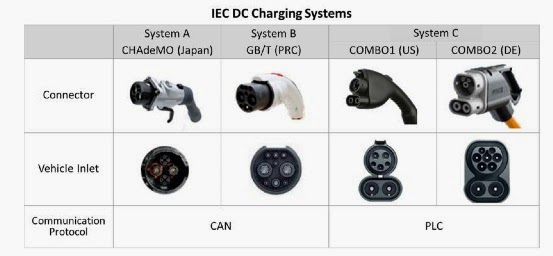
And one last kicker…adapters.  Yup. Not all charging stations use the same adapters, especially the fast charge stations and, to make matters more confusing, there are industry standards disputes going on.   Here is an image of the “short list”.

Fast Charging Adapters

Having all of these adapters in your trunk (or frunk) is EXPENSIVE.  These are not cheap, some of them costing thousands to have hanging around.

Speed Racer

Every guy with a fast car wants to race you.  I have lost count as to how many cars have tried this, and lost!

Case in point, I’m at a light when a guy in a souped up Nissan 300Zx pulls up behind me, revving his engine.  Now I know he can beat me in the long run but off the line, he is toast.  Still to give him a fair shake, I roll down my window and hold my fist out.

I count down with my fingers….1….2….3…GO!!

And leave him sitting at the light. 15 seconds later he catches up. I just look over at him and smile.

Everywhere I go, some kid in a car wants to race…same result, ever time.

Distracted Driving

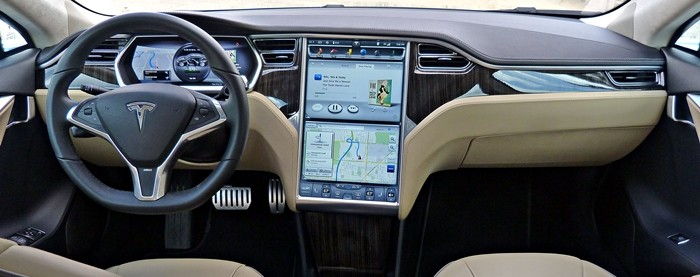
Driving an EV car is a bit like driving a cellphone with wheels.  Everything is on a touch screen and very little of it is right in front of you.  Granted Tesla was smart and put most of what I need to drive on a smaller screen where the dashboard is but still, this HUGE table in the center of the dash with all sorts of fun gadgets is DISTRACTING.

Tesla Model S dashboard

After a while, like any new car, you customize it for your needs but it does take effort not to play while you drive.

Rebooting My Car

Yes, I had to reboot my car.  As a computer scientist, this freaks me out a bit.  I know what goes on when code freezes.  The first time it happened, I was doing 84 mph down the highway…

I’m shooting down the road and decide to open my sunroof. I used the center console and slide the slider back to Open. It rejects the move and flashes an error message on my dashboard saying I am going to fast to open the sun roof.  I try again. Same error message.  Ok, not wanting to push it, I give up.

10 seconds later my dashboard freezes (the little screen, not  the big one).  I freak but the car is driving fine.  Obviously I found a bug so I wait, hoping a timeout will bring the screen back to life.

Nope…nothing.

Once I reach my destination, I call support.  Through the miracle of remote connectivity via the built in 3G network, the tech looks at my log and then proceeds to tell me how to reboot my dashboard.  Now I am grinning. This totally plays to the geek in me.  I sit and watch the computer reboot.  One minute later, I’m back among the land of the living and now armed with knowledge of a reboot sequence.

Mind….Blown.

Silence and New Noises

The HARDEST thing to get use to is the lack of noise and vibration.  You constantly feel like the car is either not running or you left it on.   Still, after a month+ I hesitate to get out of the car because I think I have left it running.  Sometimes I almost think a key would help with this haptic feedback.

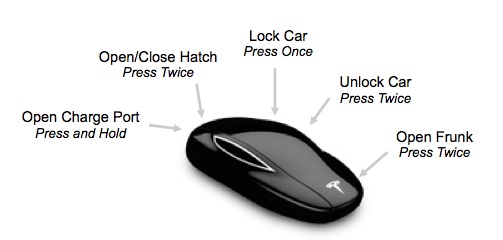
Tesla Key Fob

Now I just have a key fob hanging from my waist.  I don’t even feel it. I walk up to the car. It unlocks. I get in, press on the brake, pull the shift gear down twice to Drive and off I go.  No sound, No vibration. Just movement.

The silence is both deafening and comforting.  The car glides with a little “Star Trek” whine that makes you think you are gliding. The only noise is the light hum of the tires on the road.

This holds true for both slow and accelerated travel.  If you want to speed up, there is no revving of an engine. There is no pause of as the transmission moves between gears.  You just silently float MUCH FASTER.

ODD PEOPLE BEHAVIOR

This is probably more of a Tesla thing (kudo’s to Tesla for creating a brand) but random people talk to me about the car or say “nice car” to me as I roll by.  I catch people rubber necking and pointing.  Sure. I get a kick of pride out of it but it’s a tad uncomfortable at times.

People ask me questions all the time and I find myself selling the car.

The Club

EV ownership, for now, is a club. There is something about the new experience of driving and caring for an EV vehicle that brings people together.  You find yourself seeing other EV cars and pulling up next to them to give a “hang loose” sign.

The Club also seems to have this innate desire/drive to educate.  Everyone seems to act like an apostle, trying to convert the yet-to-be initiated.

Feeling like I am doing something positive

Lastly, as I slowly forget to stop at gas stations, I realize I am making a change that is positive. As I read about Global Warming and worry about the world I will leave my kids, I take a bit of comfort that I am helping make a change by reducing my footprint.  I plan to reduce my footprint further with solar and storage but that is a future task for a future day.  For now I’ll take my little win with me as I silently sneak up on people in my EV car.

AI and the Interstellar Space Paradox

I’ve been thinking long and hard about the issue of AI and morality.  If you read the news, you know I am not alone and for good reason. There are so many ways one could imagine an AI system determining certain outcomes that might not exactly be to the benefit of man.

Consider my own little AI brain teaser…

Interstellar Space Paradox

Imagine a AI-controlled space ark, travelling millions of miles to a remote star system. There are thousands of souls aboard, sleeping comfortably in cryo-sleep. Along the way a small meteorite strikes the ship, temporarily causing a loss of precious oxygen.  The oxygen stores are depleted by 30% and calculations show that there is not enough oxygen for all of the souls to make it to the destination.  Someone in cryo-sleep has to die but who? 

The AI now has to make a moralistic decision that even a human would struggle with. Does the AI do the math and kill off occupants? If so, who and how do you choose? Should the AI wake humans to make the decision? 

All of these decisions should not be made by one AI based on a set of “learned” response or at least there should be another AI or human that acts as a check. 

SMITE, the God AI

So the obvious first solution to the Interstellar Space Paradox is, “We will build morals into the AI!”

But this is where the problems begin. If we build decision making into an AI, how does one build an AI that will not decide to either ignore an outcome or build it’s own set of morals as it matures?  A true AI is supposed to learn from decisions it makes.  Like a child, it is supposed to make mistakes, learn from them, and then not make the mistake again.

Let’s unravel this further.

  • How do I teach an AI to make life or death decisions?
  • How can an AI learn life or death decisions without “breaking eggs” (aka killing humans) along the way?
  • What if an AI decides that humans are the problem variable in an equation and decide to “remove” us?
  • How do we know AI morals will equate to Human morals?

This is just a short list of questions AI moralists are asking themselves….

In my opinion, building morals into an AI system, as hard as that will be, will not suffice. I have a hard time imagining any way in which an AI will not eventually learn to modify it’s own code, it’s own thoughts, it’s own MORALS.

To this point, it seems the only way to add an additional level of humanistic control would be to introduce another AI who’s job was to act as the moral guard-band – a separate AI (I call SMITE) that can oversee the decisions of the first AI and act as a overriding figure (aka GOD) should decisions loose there moral basis. This at the very least prevents the original AI from overriding it’s own intent.

Granted, SMITE too could be coerced but in the end this is equivalent to two humans.  We too can be corrupted and coerced but at the very least there would be another voice of potential reason to contend with. It’s simply too dangerous to give one AI complete decision making control is so many situations.

I am sure there were times in our live where would could have all used a SMITE. Why not do that same for our AI prodigy?


Suppressing Color to Make Color

Often we think of adding color (“painting or pigments”) as the only means of creating color but thanks to the neverending spectrum of light, which contains all colors, nature chose to employ nanotubes to create new colors where there were no pigments to be found.
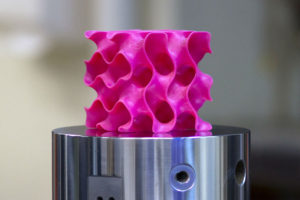
I know this sounds a bit crazy.  I swear I haven’t been drinking (it’s too early).

Scientist have found that some bugs, like this green hairstreak butterfly actually use gyroid nanotubes to trap and redirect light, causing some of the spectrum to cancel itself out.  As you can imagine, when certain spectrums of light cancel, you are left with the rest.  In this case, green.

What the heck is gyroid?

To quote Mark Turner,

Gyroid structures within butterfly wings are chiral periodic structures with a cubic symmetry. They are the subject of rapidly increasing interest in photonics, with applications from photonic crystals (PCs) and metamaterials to optical materials with topological complexity, owing to their unique geometrical properties. The strong chirality phenomenon of gyroid structures results in the ability to manipulate optical circular dichroism and has even been used as a new miniature chiral beam splitter. Gyroid structures have also been predicted to exhibit frequency-isolated Weyl points with gapless surface dispersions and line nodes, similar to Dirac points in two-dimensional periodic systems.

Boiled down, these structures, created by Nature, have the ability to act as optical filters by causing certain frequencies of light to cancel out within the structure thereby only reflecting certain wavelengths and creating color by removing color.

References:

Cannabinoid Confusion

“Note: This article is neither an endorsement or criticism of THC use. It is merely a thought exercise.”

If you want a blatant “slap in the face” about how little we understand brain chemistry, do what I did.

Google on over to the Scientific American website (love this magazine).  Now search for the term “THC”. At the time this post was written, the search returned 2756 references/articles. Just panning through the titles of these articles will quickly illustrate the confusing state of the industry around the use, effects, detractors, and benefits of THC.

Consider just a few articles:

So why the confusion?

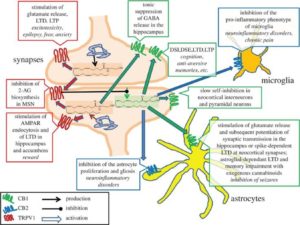
There are many factors involved, including the type of cannabinoid ingested, but the leading factors appear to be related to the various receptors in the body to which they bind, more specifically the G-Coupled Protein receptors.
Further study of cannabinoid receptors has revealed the presence of two types of receptors CB1 (brain) and CB2 (immune and blood cell production).  While these receptors are about 50% identical, there are certain differences with respect to their binding criteria.

The optimal path forward would appear to be the ability to clearly delineate these differences and develop THC equivalents (natural or man-made) that can target CB2 reception over CB1, depending on the result intended (ex. pain management versus glaucoma versus seizure control).

While we don’t recommend running out and buying THC, the promise of this until-recently frowned upon drug is intriguing and bears watching.  Perhaps there will someday be a natural “hemp that helps” instead of hinders.  Regardless, the brain continues to surprise on a daily basis.

The Future of Energy – “Did we miss something?”

Any discussion about energy production includes the usual cast of characters:

But in reading through some of the material from this years World’s Fair/Expo 2017 I got to thinking, are their viable alterative energy sources on the horizon?  I figured it was time to catch up on some reading!

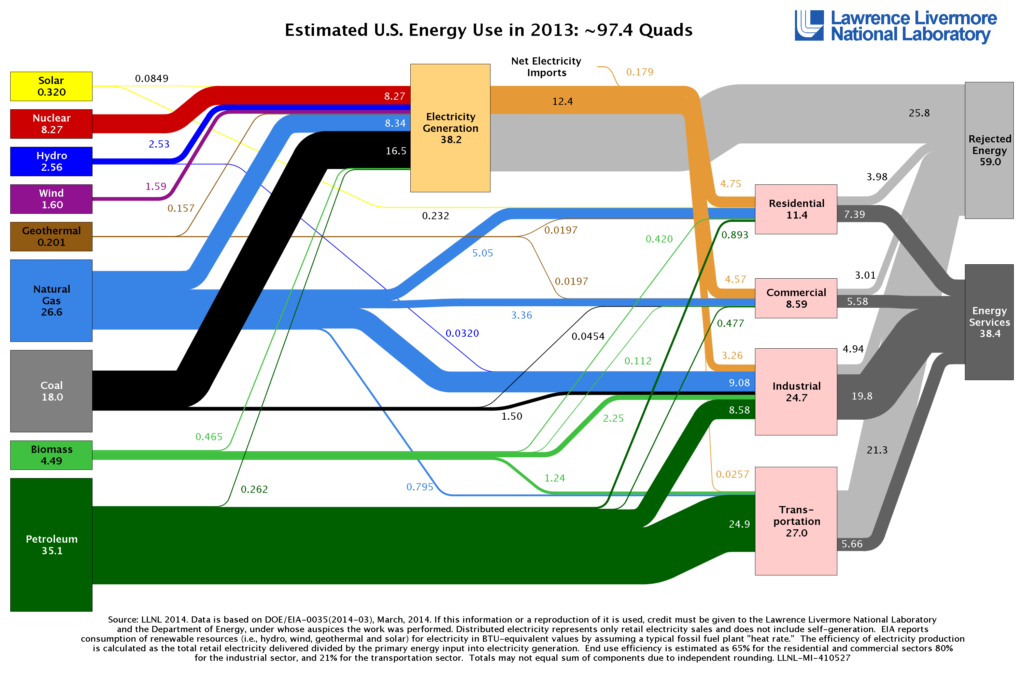
As a frame of reference, consider that the amount of active solar power in the US in 2016 generated enough electricity to power 6.5 Million homes. 

Drag Static Electrical Generation (or tether)

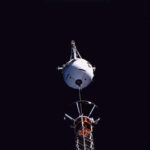
The basic physics is sound.  Use the electromagnetic field of the earth as a means of generating power for space exploration (or perhaps for terrestrial use).  As recent as 1996 NASA testes a 20K meter long tether that generated 3500 Volts. The rumor is the only reason it failed was the current melted the tether insulation causing a failure.
Lightning Energy

Putting aside the nearly impossible task of directing lightning, there are roughly 1.4 Billion strikes per year, of which about only 25% hit the ground.  At around 1 Billion joules (approx 1GigaJoule or GJ) of energy per strike, given a family uses approx 100 GJ per year, you could power about 2.5 Million homes for a year if you had PERFECT energy capture.

Gavitational Energy

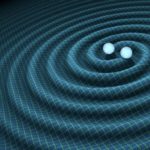
Yes, gravitational waves exist. One hundred years after Einstein postulated the existence of gravity waves, it was recently proven to be true.  The collision of a couple of blackholes created such a stir, they created ripples in space and time, i.e gravity waves that were measure at two locations in the US.  Imagine the relative energy of capturing the potential between two gravity waves?!?!
 

Molten Salt Reactors

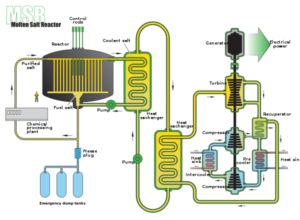
Ah, old technology made new.  The concept of salt-based reactors has been around since the 1960’s. While there are many variants, the basic concept  is Uranium Tetraflouride is melted into a salt coolant mixture.  This mixture has the double benefit of burning at very high temperatures and efficiency while also making it nearly impossible for a meltdown to occur as a coolant “leak” would also drain the fuel since they are one in the same! Brilliant!  There has been a recent resurgence in this tech and new hope is on the horizon. Seems the biggest obstacle is “politics”, of course.